Do Birds Under Solar Panels Cause Damage?
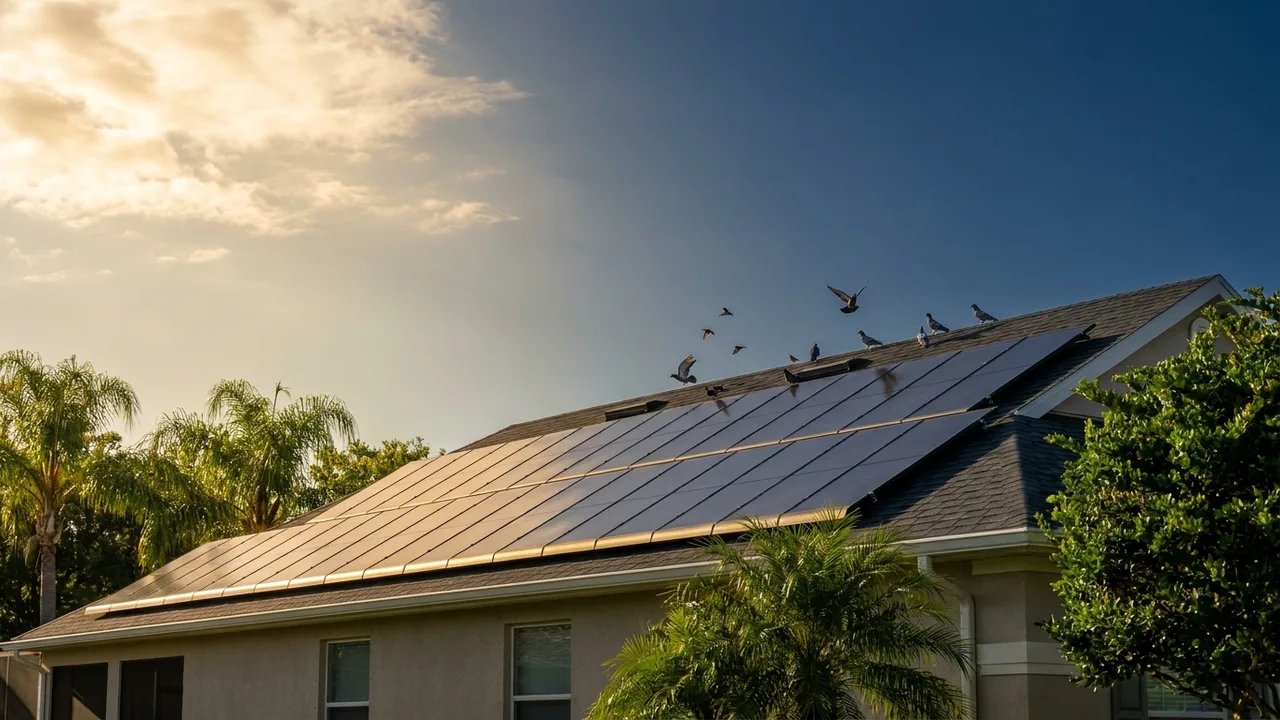
- Yes, the damage is real — chewed and dislodged wiring, corrosion, and blocked airflow (per pest-control specialists like Bird B Gone).
- Droppings are acidic and eat through electrical parts, shingles, and tiles.
- Nest material next to a hot connector is a genuine fire hazard.
- That warm, hidden gap under your panels is exactly what pigeons and other birds are looking for.
- Critter guard seals the perimeter with no holes in your roof and costs far less than the repairs it prevents.
What ends up living under your panels
We clear them out, then seal the gap so they can't come back.
Do birds under solar panels actually cause damage?
They do — and it's usually a lot more than a mess on the glass. Here's what we see on Central Florida roofs, cheapest to most expensive to fix.
1. Chewed and dislodged wiring. As birds move around building nests, they peck at, chew, and knock loose the DC wiring under your panels. That can take a single panel or a whole string offline, and damaged wiring is a genuine fire hazard (as pest-control specialists like Bird B Gone warn). This is the failure that turns a bird problem into a solar panel repair call.
2. Acidic droppings that corrode. Bird droppings are highly acidic. Left on the array, they eat into your connectors and equipment; down on the roof, they chew up shingles, membranes, and tiles. On the glass itself, they leave shaded hot spots that stress the cells — the output side is covered in how bird droppings cause output loss.
3. Blocked airflow and drainage. Nests, feathers, and debris packed under the panels stop water from draining and air from moving. That trapped moisture and heat wear on both the roof and the panels over time.
4. Fire risk. This is the one that gets me every time. Nest material is dry twigs, leaves, and grass — flammable — and it's sitting right next to live electrical connections. That combination is exactly why I don't tell customers to wait on a bird problem.
Why do birds nest under solar panels in the first place?
Because it's the perfect home. The gap between your panels and your roof is warm (the panels throw off heat), shaded, hidden from hawks and owls, and out of the wind and rain. Pigeons especially need cover over their heads to nest, and the underside of your array gives them exactly that. Once one pair moves in and raises young, they come back and multiply — so a small headache this spring becomes a colony next year. The full picture is in our bird and critter protection guide.
Is this worse in Florida?
Our climate doesn't do us any favors. Warm roofs year-round mean birds never get the hard winter break they'd get up north, so the nesting pressure runs a lot longer here. And it isn't only birds — squirrels and rats use the same sheltered pocket and chew wiring just as fast. If you're already fighting pollen and grime cutting your output, a nest of birds on top of that is a double hit to your production.
What are the signs I have birds under my panels?
You usually notice it well before you ever see a nest:
- Cooing, scratching, or flapping up on the roof, especially at dawn.
- Droppings and streaks down the face of the panels or pooling on the roof.
- Nesting material — twigs, straw, feathers — poking out from under the panel edges.
- Birds landing over and over at the same spot on your roofline.
- A production dip on your monitoring app from shading or damaged wiring.
Can I just remove the nest myself?
I'd be careful. Past the risk of falling off a roof, you can disturb wiring you can't see, and droppings and nest debris carry health hazards that need proper cleanup and protective gear. There can also be rules around active nests depending on the species and the timing. Our approach is to humanely clear the area first, inspect the wiring for existing chew damage, clean up the droppings, then seal the perimeter so they can't come back.
How do you keep birds out for good?
The fix that lasts is critter guard — low-profile mesh clipped around the whole edge of your array. Done right, it:
- Clips to the panel frames with no roof penetrations — no drilling into your roof or your modules.
- Seals every gap around the full array so birds and squirrels can't crawl underneath.
- Stays nearly invisible from the ground — thin mesh tucked under the panel edge.
It protects the expensive part — your wiring and your roof — for a fraction of what a chewed-wire repair or roof fix would run. Want the perimeter check bundled with regular cleanings and an annual inspection? A maintenance plan keeps it all on one schedule. Service Solar Pros protects arrays across Orlando and all of Central Florida — any brand, any installer.
Frequently asked questions
Do birds under solar panels cause damage?
Are bird droppings on solar panels really harmful?
Why do birds keep nesting under my panels?
Can you remove birds already nesting under my solar panels?
Does critter guard damage my roof?
Serving solar owners across Central Florida
We clean, repair, maintain and protect solar systems throughout the region — any brand, any installer. Find your town:
Need a hand with your solar?
Service Solar Pros — any brand, any installer, across Central Florida. Call (407) 270-2542.
Get a free quote