Automatic Solar Panel Cleaning Systems: Worth It in Florida?
Want a pro to take a look? Call (407) 270-2542 or request a free quote.
- Rain alone did not bring pollen-coated panels back to full output in an NREL-led study.
- Hard water sprayed on hot glass leaves mineral spots, and some panel makers do not cover cleaning damage.
- A soft-wash visit also checks for cracks, hot spots, loose connectors and critters.
What is an automatic solar panel cleaning system?
An automatic solar panel cleaning system washes or brushes the panels on a timer, without a person on the roof. There are three main kinds: sprinkler-style spray nozzles fixed along the panels, robots that drive along a row with a rotating brush, and waterless robots that sweep dust off. Most are used on solar farms.
Researchers who compared cleaning methods put them in three groups (Ilse et al., Joule, 2019):
| Method | Upfront cost | Labor | Where it is common |
|---|---|---|---|
| Manual cleaning (a crew with brushes) | Low | High | Everywhere |
| Semi-automatic (truck-mounted brushes, portable robots) | Medium | Medium | U.S. and German solar farms |
| Fully automatic (fixed robots or spray systems) | High | Low or none | Extremely dusty sites |
A home sprinkler-style system is the type you are most likely to see sold for a house. One U.S. maker, Heliotex, describes "independently programmed rinse and wash cycle[s]" that use biodegradable cleaning concentrate from fixed nozzles (Heliotex).
Do automatic cleaning systems work on Florida homes?
They can move dust, but they are a poor match for most Florida roofs. Our soiling is not dry desert dust. It is sticky oak and pine pollen, lovebug residue and bird droppings that bake onto hot glass. A timed spray loosens some of it, but a soft brush and a proper rinse are what lift it cleanly.
Fully autonomous cleaning made up only about 0.13% of the world's solar capacity in a 2019 review, and it was most common where soiling is extreme (Ilse et al., 2019). The same review says no single cleaning method is right everywhere; it depends on local conditions, water and access.
Florida adds hard tap water and very hot midday glass, covered below. For how our pollen behaves, read how Florida pollen affects solar panels.
Can Florida rain clean solar panels for you?
Rain helps, but it does not finish the job. In a study of five solar plants in North Carolina, panels coated in spring pollen lost up to 15% of their output at peak season, and they did not return to their cleaned output even after frequent rain. Without planned cleaning, yearly losses were around 10%.
That study was led by the National Renewable Energy Laboratory and published in the IEEE Journal of Photovoltaics (NREL news release, Dec. 18, 2023). After a mechanical wet-brush cleaning, the plants gained 5% to 11% in output. Those were utility-scale plants, not Florida homes, so your roof will vary.
Panel angle matters too. Field studies show dirt builds up faster on flatter panels (Ilse et al., 2019), so a low-tilt angle roof holds water and grime instead of shedding them. This is how soiling loss creeps up on a system that "gets rained on all the time."
What can go wrong with a rooftop sprinkler or robot?
The main risks are mineral spots, cracked glass and a warranty claim that gets refused. Florida tap water is hard, and when a sprinkler sprays it on hot panels, the water evaporates and leaves chalky spots that block light again. Cold water on hot glass can also stress the cells.
Here is what to weigh before you put one on your roof:
- Hard water spotting. Unless the system feeds purified water, every cycle can leave a fresh mineral film. We explain why in hard water spots on solar panels in Florida.
- Thermal shock. Researchers note that cleaning a hot module with cold water can break cells or spread micro-cracks (Ilse et al., 2019). Qcells tells owners to "only clean modules that have cooled down" (Qcells Q.TRON M-G2.X manual, 2023).
- Your panel warranty. Qcells states that damage "caused by the cleaning or related to the cleaning tools or agents" is not covered by its product and performance warranty, and that cleaning should be done by qualified personnel. Check your own panel manual first.
- Brushes, grit and soap. Harsh cleaning can scratch the glass's anti-reflective coating (Ilse et al., 2019), and Qcells warns against abrasive materials. It is the same reason we never pressure wash solar panels.
- More hardware on the roof. Water lines, nozzles and a controller are more parts to maintain, and more to remove if you need a new roof.
How does the cost compare with professional cleaning?
An automatic system means paying more upfront to pay less for labor later. Researchers class fully automatic cleaning as high capital cost and low labor, and manual cleaning as low capital cost and high labor. On a home with one roof, the upfront cost rarely spreads over enough panels to pay back the way it can on a solar farm.
The 2019 review also found that cleaning rooftop systems costs 3 to 8 times more than cleaning ground-mounted ones (Ilse et al., 2019).
We price cleaning per panel, so your panel count drives the cost, and every quote is free before any work starts. For national price ranges and what moves the number, see solar panel cleaning cost in Florida.
Do anti-soiling coatings remove the need to clean?
No. An anti-soiling coating is a clear layer on the glass that helps dirt slide off. Researchers who reviewed soiling fixes found that no coating has removed the need for cleaning. Coatings can stretch the time between cleanings, but over long periods they typically cut soiling by only about 20% to 50%.
Coatings also wear down from cleaning, sun and heat (Ilse et al., 2019). Treat one as a small help, not a cleaning schedule.
When does an automatic system make sense?
It makes most sense on large arrays where labor is the big cost and the dirt is dry dust. Think of a solar farm in a desert, or a very large commercial roof with safe water and drain access. For a typical Central Florida home, a cleaning every 6 to 12 months is usually enough.
Here is a simple guide:
| Your situation | Better fit |
|---|---|
| Typical home roof, 1–2 cleanings a year | Professional soft-wash |
| Under oak or pine, or heavy bird activity | Soft-wash every 3–6 months, or a maintenance plan |
| Two-story or steep roof | Professional soft-wash (no DIY, no rooftop plumbing) |
| Very large array with dry, constant dust | Ask about automatic or semi-automatic cleaning |
Not sure how often your roof needs it? Read how often to clean solar panels in Florida, or see whether you can clean solar panels yourself.
What does a professional cleaning catch that a robot misses?
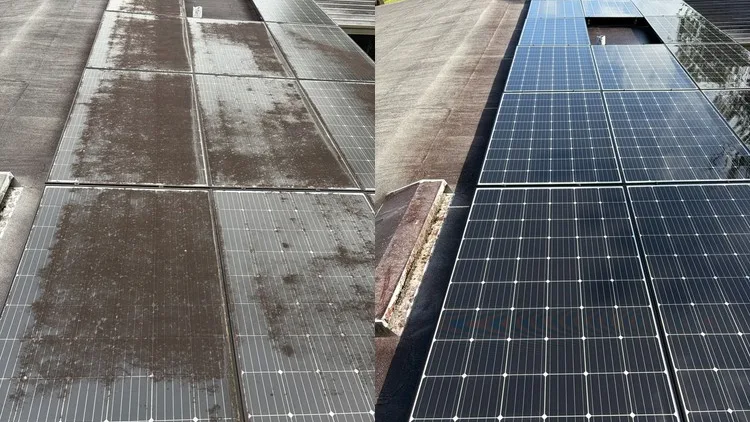
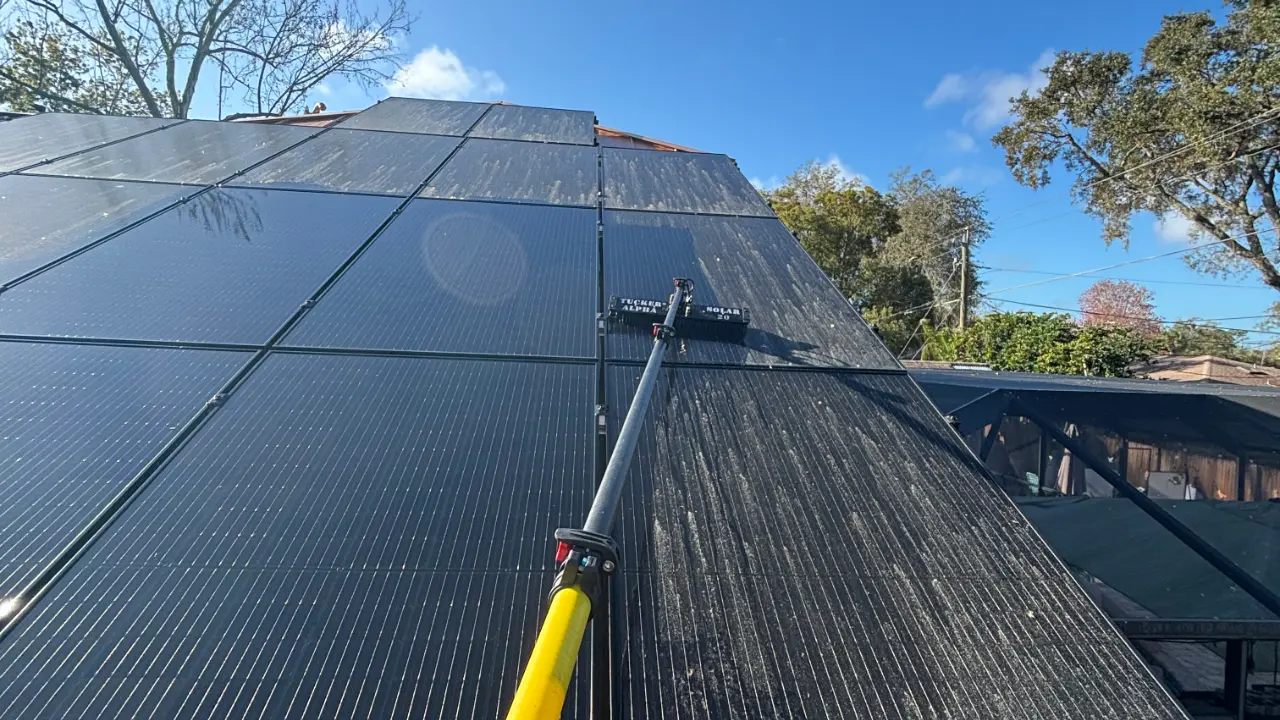
A person on the roof can see problems a sprinkler cannot. On every Service Solar Pros cleaning visit, we soft-wash with purified water, run a quick production check, and look for cracks, hot spots and loose connectors. We also check for birds and debris around the array, and we send before-and-after photos of every panel.
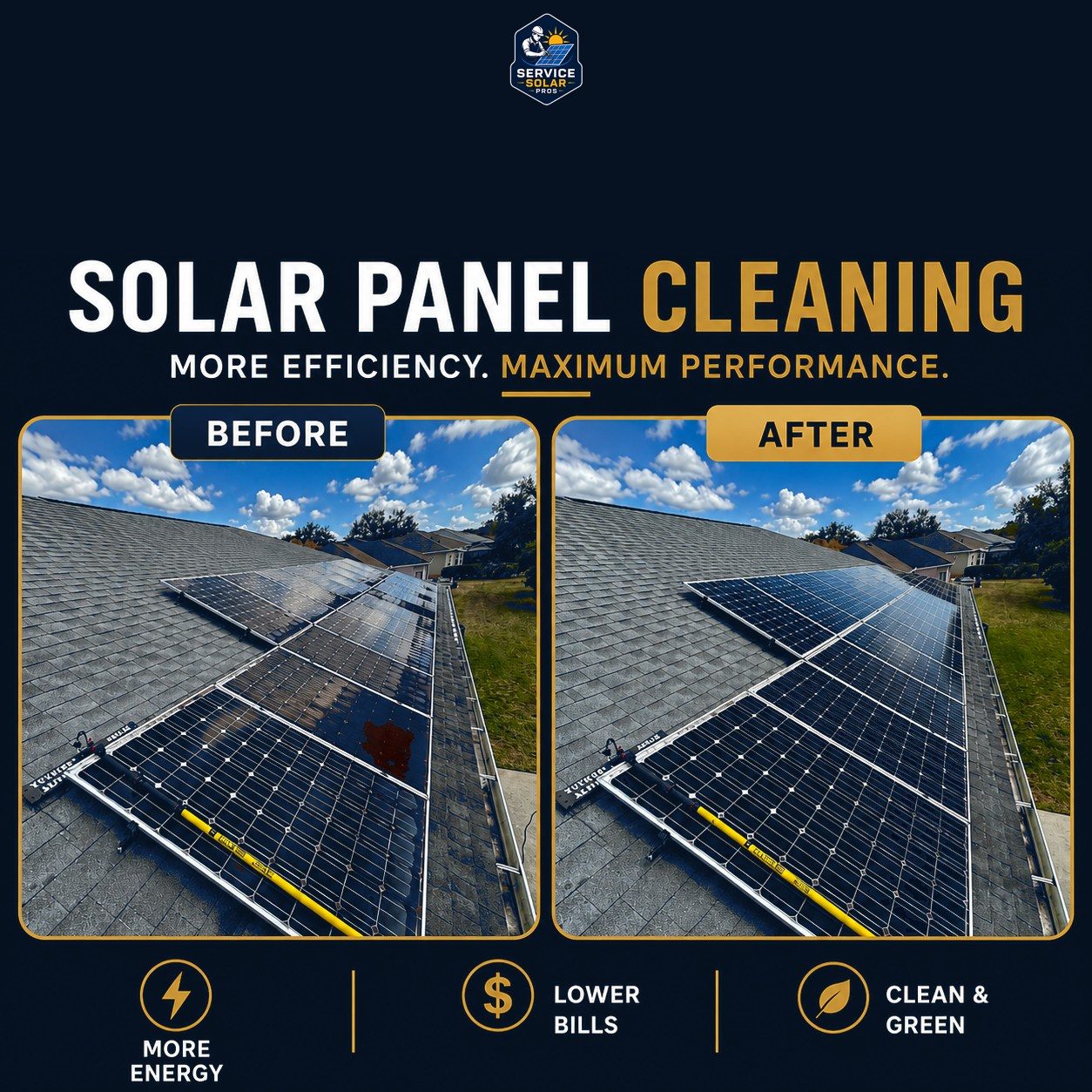
In Central Florida, birds and squirrels move in under panels and chew wiring, and a robot will wash right over a nest. If we find critters, a solar critter guard seals them out. If a panel shows heat damage, read solar panel hot spots explained.
We use deionized (DI) water cleaning on spot-prone roofs, so the glass dries clear. We are fully insured, and we clean any brand from any installer across Central Florida. Learn more on our solar panel cleaning page.
Frequently asked questions
Do automatic solar panel cleaners void the warranty?
Can I just let Florida rain clean my solar panels?
Are robotic solar panel cleaners used on homes?
How often should Florida solar panels be cleaned?
Do anti-soiling coatings mean I never have to clean?
Related reading
Next step: see Solar panel cleaning in Central Florida, or read a related guide:
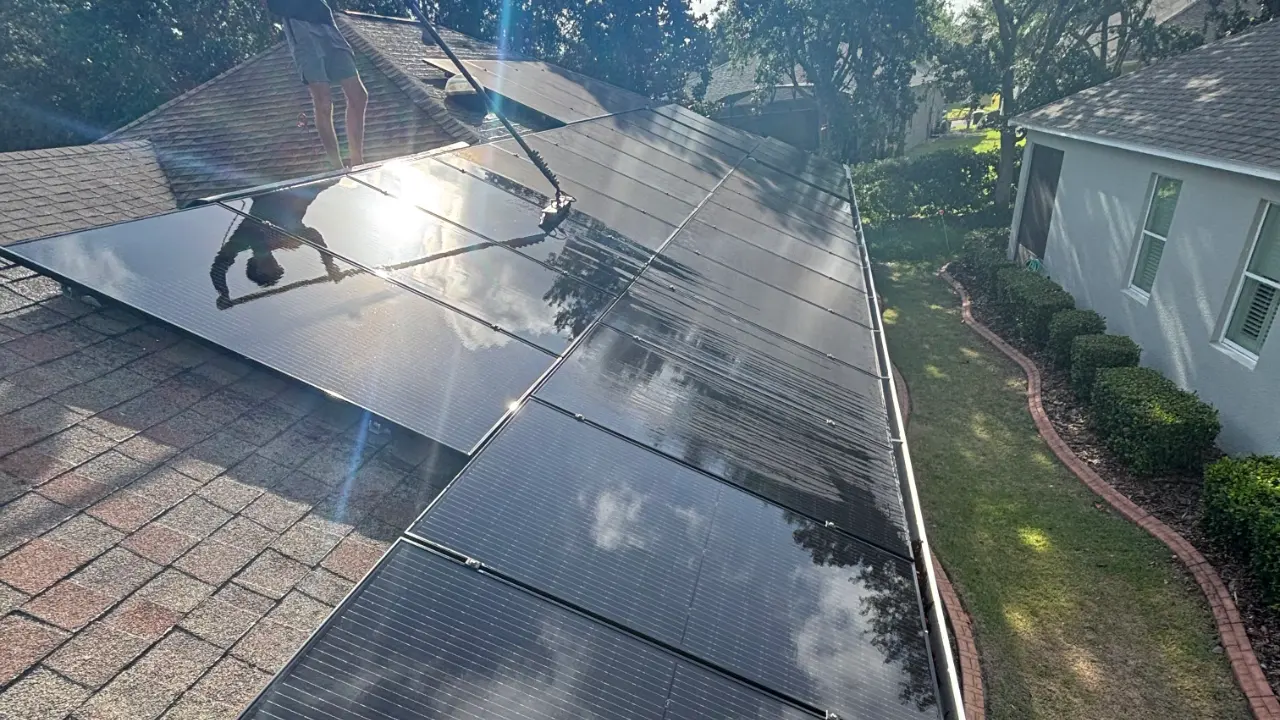
Serving solar owners across Central Florida
We clean, repair, maintain and protect solar systems throughout the region — any brand, any installer. Find your town:
Need clean panels without the rooftop plumbing?
We soft-wash any brand, any installer, across Central Florida, and send you the before-and-after photos. Call (407) 270-2542 or get a free quote.
Get a free quote