How Does Florida Pollen Affect Solar Panels?
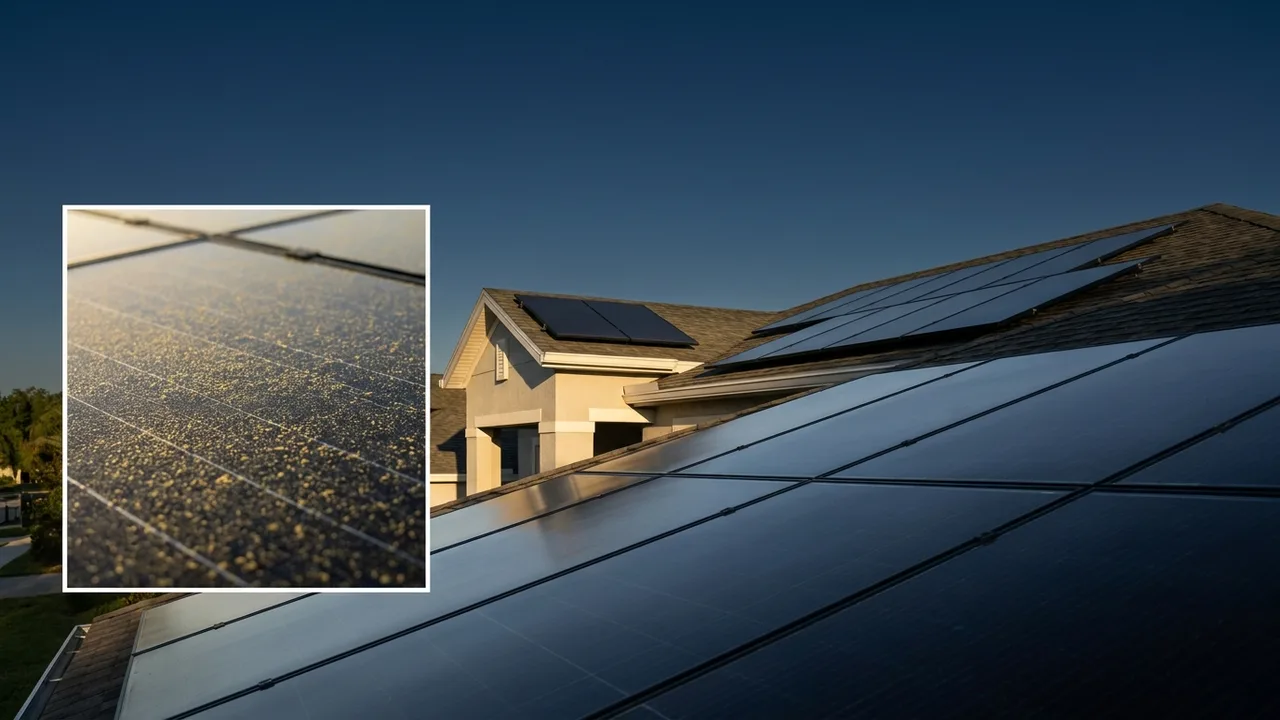
- Oak and pine pollen coats panels from late February through May, peaking in March and April (UF/IFAS).
- Southeast solar research found soiling losses up to 15% at peak pollen season, around 10% annually.
- Rain won't fix it. NREL found precipitation doesn't restore panels to cleaned output.
- A cleaning after pollen season (late spring) recovers most of the lost production.
How much output dirty panels give up
Typical Central-Florida soiling losses on a neglected array. A professional cleaning wins most of it back. Sources: NREL; IEEE Journal of Photovoltaics.
When is Florida's pollen season for solar panels?
The heavy window runs late February through May, with tree pollen peaking in March and April, according to UF/IFAS. Live oak is the worst offender in Central Florida, and it's the sticky, yellow-green kind you see filming over cars, patios, and screens. Pine piles on top of it. If it's coating your driveway, it's coating your array.
That's why our most-booked schedule includes a late-spring cleaning right after pollen tapers off. Our Florida cleaning guide lays out the full year-round timing.
How much output does pollen cost you?
Pollen isn't just cosmetic. When NREL and IEEE Journal of Photovoltaics researchers studied solar systems in the pollen-heavy Southeast, they measured production dropping by as much as 15% during peak pollen season, with roughly 10% annual losses when panels weren't cleaned on a schedule. Those figures are from utility-scale plants in North Carolina, so a Florida home roof will vary, but the pollen-soiling mechanism is exactly what we deal with here.
Losing even 8-10% means buying that power back from the utility every month, right through the sunniest part of spring when your panels should be at their best. That's the frustrating part of pollen season: your system has plenty of sunlight to work with, but a bonded film is skimming a slice off the top of every single day. See how dirty solar panels lose efficiency for the full breakdown.
Why doesn't Florida rain wash the pollen off?
This is the part that surprises people, because we get so much rain. NREL studied it and found that even frequent rain did not return panels to their cleaned output. Pollen bonds to the glass, and rain only rinses the loose top layer while the sticky bonded layer stays put.
Worse, a light rain can turn dry pollen into a muddy film that dries into streaks, so the array can look and perform worse right after a shower. Bonded pollen has to be gently washed off, not rinsed.
What cleaning schedule handles pollen best?
For most Central Florida homes, the answer is a late-spring clean once the March-April pollen has finished falling, plus a fall clean to clear the summer's dust, lovebugs, and droppings. Homes under oak or pine canopy often add a mid-season visit, because they collect pollen faster than an open roof does.
The easiest way to keep pace is a maintenance plan, which times the cleanings to the season so you never lose output to a pollen film. We serve Mount Dora and all of Central Florida, any brand, any installer. Get a free quote on our contact page or call (407) 270-2542.
Frequently asked questions
How does Florida pollen affect solar panels?
When is pollen season worst for solar panels in Central Florida?
Will rain wash pollen off my solar panels?
How often should I clean panels because of pollen?
Serving solar owners across Central Florida
We clean, repair, maintain and protect solar systems throughout the region — any brand, any installer. Find your town:
Need a hand with your solar?
Service Solar Pros — any brand, any installer, across Central Florida. Call (407) 270-2542.
Get a free quote