
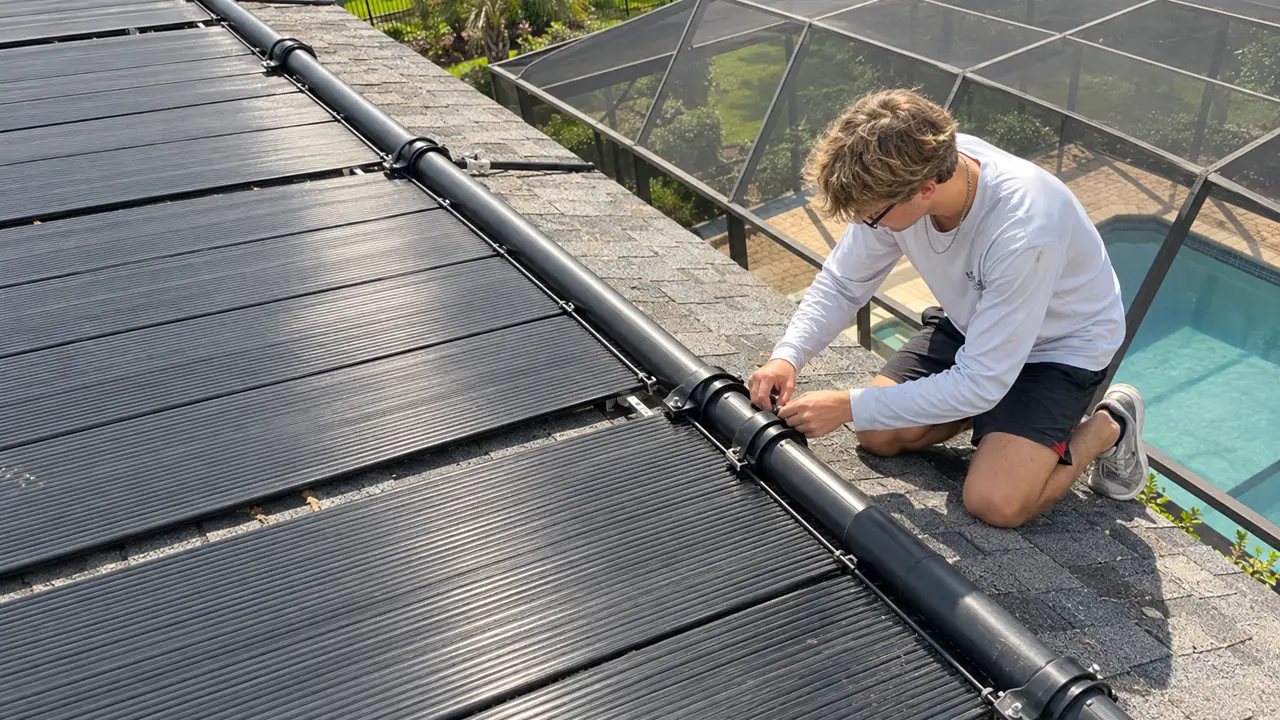
AI-generated image
Want a pro to take a look? Call (407) 270-2542 or request a free quote.
- Your pool pump does the work. If it does not run in the sunny hours, the panels can't heat anything.
- The automatic controller and its sensors decide when water goes to the roof. Check the settings first.
- A leak or a spray of water on the roof usually means a split panel or a loose fitting.
- After a storm, check the straps and hold-downs that keep the panels on the roof.
- A roof leak under the panels is a roofer's job, not ours.
Pool solar basics: how the heater works
A solar pool heater is mostly plumbing. Your pool pump pushes water through the filter, and a valve sends some or all of it up to the collector panels on your roof. The sun warms the water as it runs through the panels, and it flows back down into the pool. The federal Department of Energy's Energy Saver guide on solar pool heaters describes the same basic parts: the collector, the filter, the pump and a flow control valve.
Most systems also have an automatic controller with two sensors, one for the pool water and one for the roof. When the roof is warmer than the pool and the pool is below your set temperature, the controller turns a motorized valve and sends water up. Fafco and Heliocol both build panels for this kind of system, and we service both.
Not heating: the usual causes
When someone calls us about cold water, it is usually one of these:
- The pump schedule is too short. If the pump runs early in the morning and shuts off before noon, the panels never get water during the hours the sun is strongest.
- The controller is set wrong or a sensor has failed. A set point that is too low, a controller stuck in "off," or a sensor reading the wrong temperature will keep water off the roof.
- The valve actuator is not turning. The motor on the diverter valve wears out, or the valve itself sticks, and water just bypasses the panels.
- There is a leak. Split panels, worn couplings and cracked fittings let water out and air in.
- The panels are clogged or dirty. Debris can block flow, and a heavy coat of grime on the panels cuts how much heat they pick up.
Homeowner checks: what to look at first
Start on the ground with your pump timer, and make sure it runs through the middle of the day. Then look at the solar controller, if you have one. Check that it is on, set to automatic and set to a temperature above where the pool is now.
On a sunny afternoon, stand near the pool equipment and listen. You should hear water moving to the roof when the system calls for heat. The water coming back into the pool should also feel warmer than the pool itself.
Then look up from the yard. A spray or trickle coming off the roof, or a dark wet patch on the shingles, points to a leak. Don't climb up to look closer, because a wet roof is slippery and the panels are not built to be stepped on.
Pool heater not warming? Check these first
- Check the pump timerMake sure it runs through the middle of the day.
- Check the controllerIt should be on, automatic, and set above the pool's temperature.
- Listen on a sunny afternoonYou should hear water moving to the roof.
- Feel the return waterWater coming back should feel warmer than the pool.
- Look up from the yardA spray, trickle or wet patch on the roof points to a leak.
The takeaway: Most cold-water calls start with the pump timer or the controller. Check from the ground, and never climb on the roof to look.Service Solar Pros
Service visit: what we check and fix
We work from the ground up. First we check the pump run time, the controller and its sensors, and the valve and its motor. Then we check the roof panels and plumbing for leaks, damaged fittings and loose straps, and we test that water flows through the panels and comes back warmer.
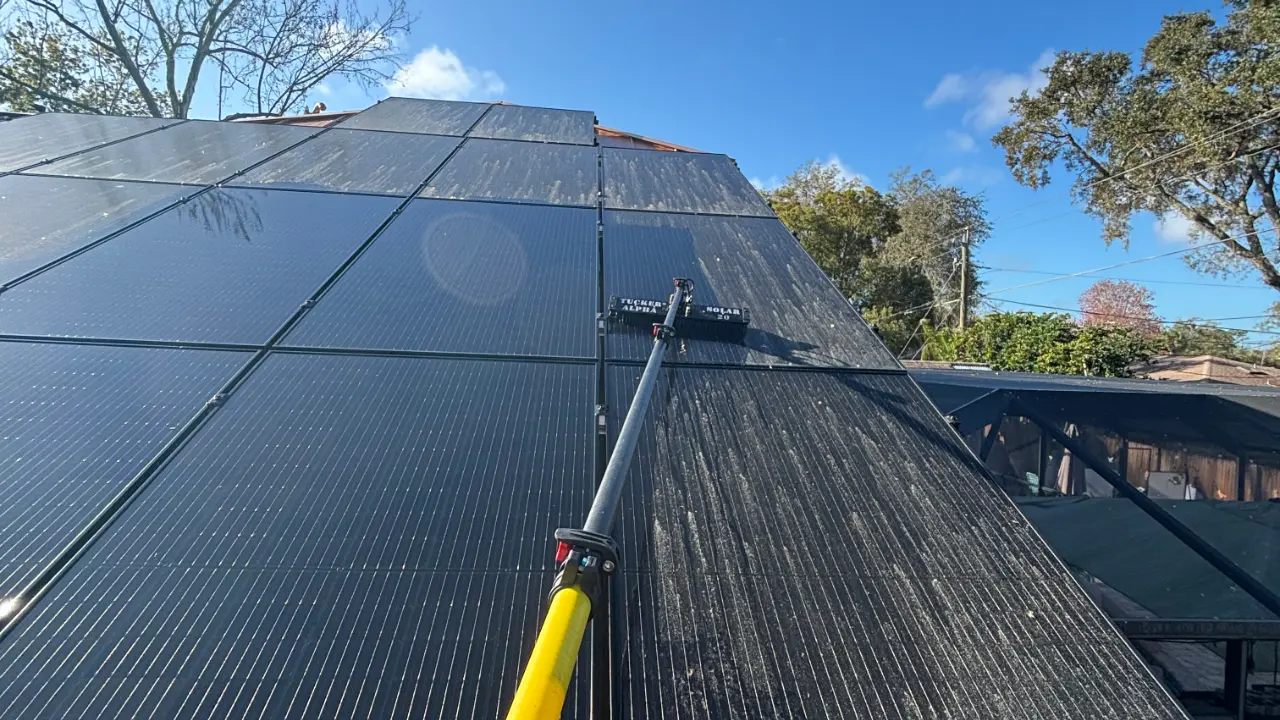
If the panels need cleaning, we clean them. If a part has failed, we tell you which one and replace it, and we give you a free quote first.
Our pool solar service page has more on what we do for pool heating systems.
Storms and freezes: what to do after
Pool solar panels are light and wide, so high wind tries to lift them. After a storm, look from the ground for panels that have shifted, straps hanging loose or a panel edge that has lifted. Have it checked before you run water to the roof again.
Central Florida does not freeze often, but it happens. Water left in the panels on a hard freeze can split them. Your Fafco or Heliocol manual explains how your system drains, so read it before a cold front shows up in the forecast.
Roof leaks under pool panels: who fixes them
A leak inside the house below the panels usually comes from a hole in the roof where a mount goes in, or from worn flashing (the metal seal around it). That is roofing work, and a roofer should handle it. We don't seal or repair roof leaks. We handle the solar pool heating system itself, so the heating side works again once the roof is fixed.
Service area: where we work on pool solar
Service Solar Pros services Fafco and Heliocol solar pool heating across Central Florida. We cover Leesburg and The Villages to Mount Dora, Clermont and Orlando. If you also have solar panels for electricity, we can clean and check those on the same visit. See all our services, or call (407) 270-2542.
Frequently asked questions
Do you service Fafco and Heliocol solar pool heaters?
Why is my solar pool heater not heating?
How do I know if my pool solar panels are leaking?
Do you fix roof leaks under pool solar panels?
Should I drain my pool solar panels before a freeze?
Related reading
Next step: see our pool solar service, or read a related guide:
Serving solar owners across Central Florida
We clean, repair, maintain and protect solar systems throughout the region — any brand, any installer. Find your town:
Need a hand with your solar?
Service Solar Pros — any brand, any installer, across Central Florida. Call (407) 270-2542.
Get a free quote