Does Bird Poop Damage Solar Panels?
- Bird droppings are acidic (uric acid) and can corrode surfaces and etch coatings if left to bake on.
- A dropping shades the cells it covers, cutting output and risking hot spots that stress the panel.
- Droppings don't rinse off in rain; they need a gentle soft-wash to remove safely.
- If birds are a repeat problem, critter guard mesh stops them nesting and fouling the array.
How much output dirty panels give up
Typical Central-Florida soiling losses on a neglected array. A professional cleaning wins most of it back. Sources: NREL; IEEE Journal of Photovoltaics.
Does bird poop actually damage solar panels?
It does, and in two separate ways. First, bird droppings are acidic, high in uric acid, and in Florida sun they bake onto the glass fast. Left in place, that acid can corrode metal surfaces and, over time, etch or dull the panel's anti-reflective coating. Second, a dropping is opaque, so it blocks the light on every cell it covers.
That combination is worse than ordinary dust, which is why droppings are worth clearing quickly instead of waiting for the next visit. Our Florida cleaning guide covers how droppings fit into a sensible cleaning schedule.
How much output do bird droppings cost, and what is a hot spot?
A single well-placed dropping punches way above its size. Because panels wire their cells together in series, one heavily shaded cell can drag down a whole string, so the loss is bigger than the covered area alone would suggest. Worse, a shaded cell can turn into a hot spot: instead of producing power, it resists the current and heats up, which stresses the panel and, over time, can cause permanent damage.
It's the same mechanism behind general soiling loss, but a dropping concentrates it in one spot, which is exactly the condition that breeds hot spots. For the full picture, see how dirty solar panels lose efficiency. If a hot spot has already scorched a cell or damaged the panel backing, cleaning won't undo it, and that becomes a job for professional solar panel repair.
Why are Florida panels a bird magnet?
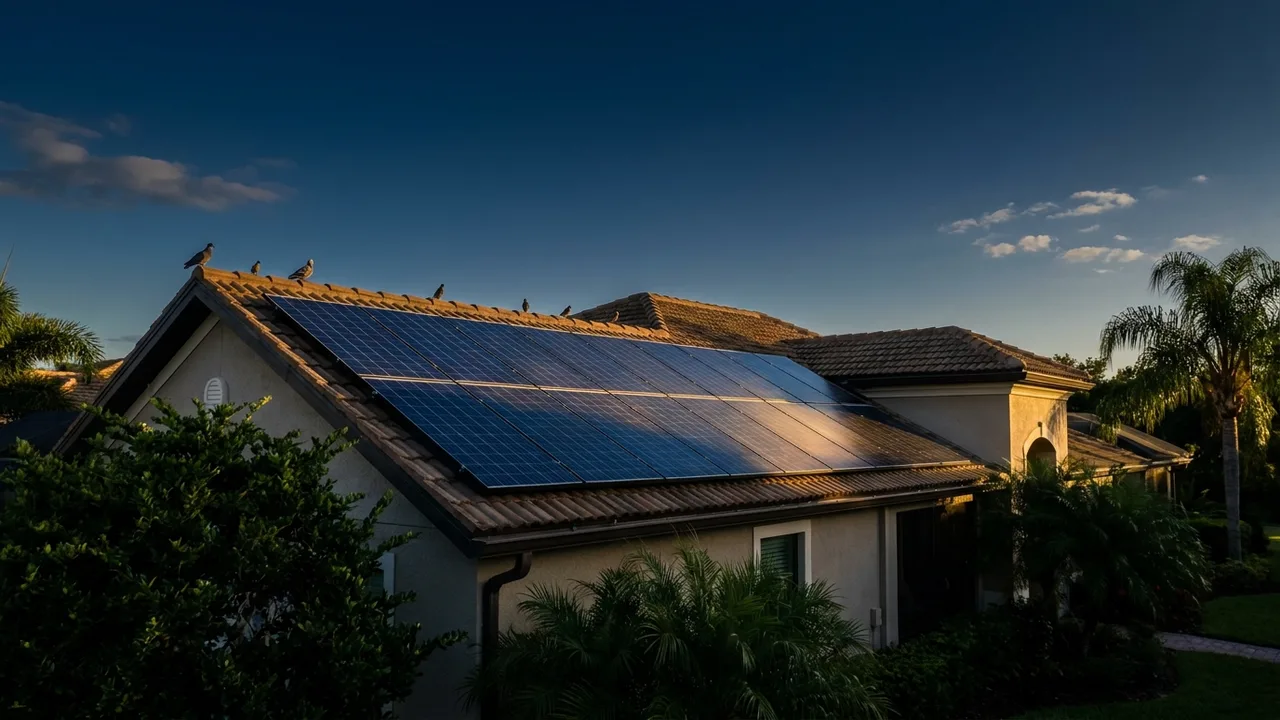
Central Florida gives birds every reason to hang around your roof. The warm gap under the panels is a sheltered, predator-safe spot to roost and nest, and our mild climate means they use it year-round. Pigeons in particular love it. The result is droppings on the glass above and nesting mess below, on top of the pollen and lovebug residue our climate already piles on.
So in Florida, bird fouling is rarely a one-time thing. If you're seeing repeat droppings, the birds have probably found a home under your array.
How do you clean and prevent it?
Two steps solve it for good:
- Clean it right. Droppings don't rinse off in rain and should never be scraped or blasted off. A gentle soft-wash with purified water lifts the acid residue without scratching the glass or risking the warranty.
- Keep the birds out. If they're nesting under the panels, cleaning alone is only temporary. A solar critter guard, a mesh barrier clipped around the array edge with no roof penetration, stops birds getting underneath in the first place.
We do both across Eustis and all of Central Florida, any brand, any installer. Get a free quote on our contact page or call (407) 270-2542.
Frequently asked questions
Does bird poop damage solar panels?
Can I just wait for rain to wash bird droppings off my panels?
How do bird droppings cause a hot spot?
How do I stop birds from fouling my solar panels?
Serving solar owners across Central Florida
We clean, repair, maintain and protect solar systems throughout the region — any brand, any installer. Find your town:
Need a hand with your solar?
Service Solar Pros — any brand, any installer, across Central Florida. Call (407) 270-2542.
Get a free quote