
How to Prepare Your Solar Battery for Hurricane Season in Florida
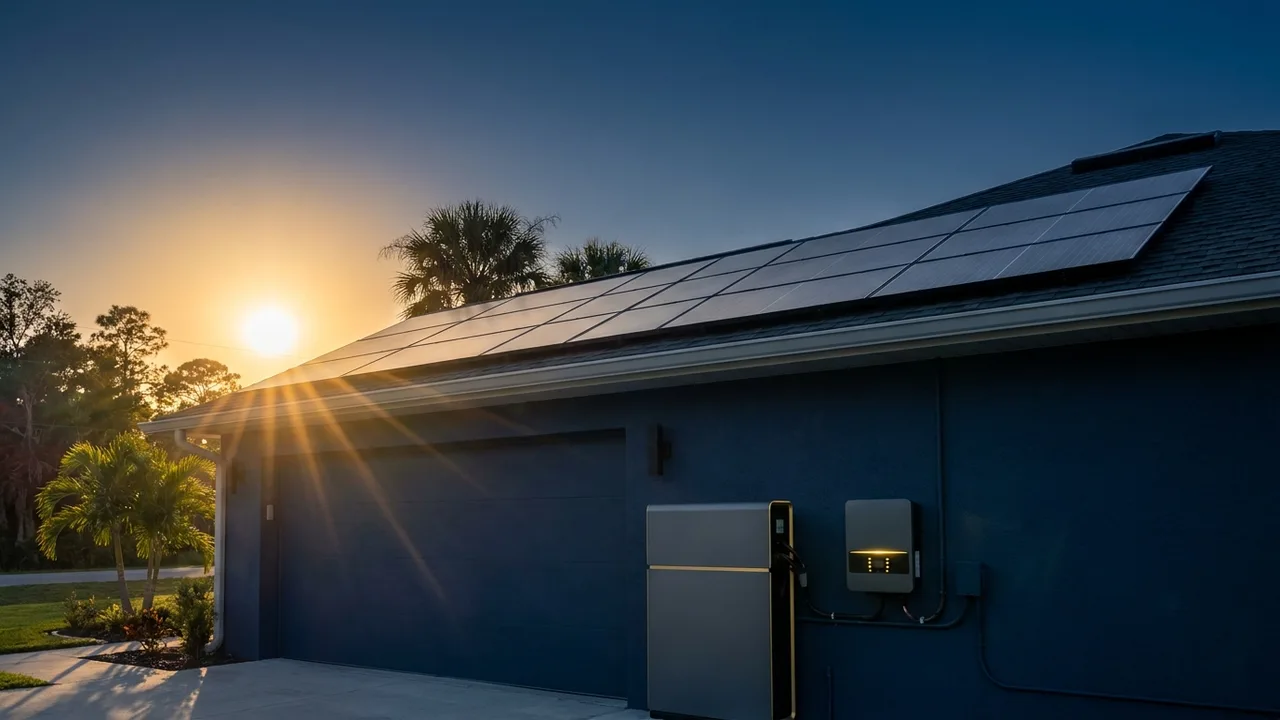
- Get storm-ready before June 1 — hurricane season runs June 1 to November 30 (NOAA).
- Test that the automatic transfer switch really islands your home when the power drops.
- Confirm the battery reaches and holds a full charge; a weak one hides until you need it.
- Update gateway and inverter firmware, and raise your backup reserve before a storm.
- Plan your essential loads so the battery lasts — and keep the panels clean so it recharges faster.
What one ~13.5 kWh battery typically backs up
Approximate runtimes — your real numbers depend on your load, and a 3–5 kW inverter caps how much runs at once. We size and test it for your home.
When should I prepare my solar battery for hurricane season?
Before June 1. The Atlantic hurricane season officially runs June 1 through November 30 (NOAA), so the window for prep is late spring — while the weather's calm and, just as important, while techs and parts are actually available. The worst time to find out your backup doesn't work is with a storm on the radar and every solar company booked solid.
And in Central Florida, storm outages aren't only the named hurricanes — summer thunderstorms knock out power from Leesburg to Kissimmee all season long. Treat this like an annual ritual, same as swapping the batteries in your smoke detectors. This checklist is part of our Central Florida solar battery backup guide.
How do I test that my backup actually works?
The single most important check is the automatic transfer switch — the device that cuts your home off from the grid and flips you onto battery power when the utility fails. If it doesn't fire, nothing else matters. A proper test confirms three things:
- The system islands your home when grid power is lost.
- The battery discharges and carries your backed-up circuits.
- The system reconnects and recharges cleanly when power returns.
You also want to nail down which circuits are actually on backup — a lot of folks assume it's the whole house when it's really just a subpanel. If you're not comfortable simulating an outage, that's a service call worth making before the season, not during it.
What should be on my pre-season checklist?
Run through this before June 1:
- Full charge test — confirm the battery hits 100% and holds it. A unit that stalls short of full or drains oddly is trying to tell you something.
- Firmware updates — make sure the gateway and inverter are current; stale firmware causes comms and charging problems.
- Backup reserve — raise it ahead of a forecast storm so you go into the outage as full as possible.
- Connectivity — check that the monitoring app and gateway are online so you can watch the battery during the storm.
- Physical check — look for corrosion, pests, blocked vents, or heat damage around the unit.
- Clean panels — clean glass recharges the battery faster between storm bands; soiling robs you of production right when you need it.
Fold this into a solar maintenance plan and it happens on schedule every spring instead of slipping your mind.
How do I make my battery last through a multi-day outage?
Plan your loads before the lights go out. A battery that could run essentials for a day or more can be drained in hours if you leave the central AC running. Decide ahead of time what's truly essential — refrigerator, medical equipment, well pump, phones, internet, a few lights and fans — and be ready to keep the big loads off.
Because your panels recharge the battery whenever the sun breaks through, that disciplined load management is what lets solar-plus-storage outlast a fuel generator across a multi-day event. We break down the numbers in how long a solar battery lasts in an outage.
Should I have a professional check it before the storm?
If your system's never been tested under a real outage, if it's been more than a year since anyone looked at it, or if you've seen any odd alerts, then yes — get it checked before hurricane season, not after it fails on you. A pre-season service verifies the transfer switch, battery health, firmware, and backup circuits so you head into June with confidence instead of a guess.
We get battery systems storm-ready across Clermont, Leesburg, and all of Central Florida — any brand, any installer, including systems whose original company has closed. It's part of our solar battery storage service.
👉 Book your pre-hurricane battery check or call (407) 270-2542.
Frequently asked questions
When is hurricane season in Florida?
What's the most important thing to test before a storm?
Should I set my backup reserve higher before a hurricane?
How do I make my solar battery last longer during an outage?
Serving solar owners across Central Florida
We clean, repair, maintain and protect solar systems throughout the region — any brand, any installer. Find your town:
Need a hand with your solar?
Service Solar Pros — any brand, any installer, across Central Florida. Call (407) 270-2542.
Get a free quote